The short answer
Tailscale and WireGuard aren't really opposites — Tailscale is built on WireGuard. WireGuard is the fast, modern VPN protocol; Tailscale is a managed mesh network that uses WireGuard for the actual tunnels and adds the hard parts on top: key exchange, NAT traversal, device discovery, and access control. So the real choice is "managed mesh (Tailscale) versus configuring WireGuard yourself."
For reaching your own servers over SSH — especially from a phone or a machine behind a home router — Tailscale is far less work. For a single, fully-controlled tunnel with no third-party coordination, raw WireGuard wins. This guide explains the trade-off.
They're not the same layer
This trips people up: comparing Tailscale and WireGuard isn't comparing two VPNs of the same kind. WireGuard is a protocol (and a tool) — you define peers, exchange public keys by hand, set allowed IPs, and open or forward ports so peers can find each other. Tailscale runs WireGuard under the hood but handles coordination for you: it distributes keys, punches through NAT so devices connect directly even behind routers, gives each device a stable IP (and a name via MagicDNS), and enforces access rules. You get a WireGuard network without writing WireGuard config.
Side by side
| Tailscale | Raw WireGuard | |
|---|---|---|
| Setup | Install, log in — done | Manual config per peer |
| NAT / CGNAT traversal | ✅ automatic | ⚠️ you handle it (port forward / relay) |
| Key management | Automatic | Manual key exchange |
| Device naming (DNS) | ✅ MagicDNS | ❌ raw IPs |
| Access control | ✅ ACLs | Via firewall rules |
| Raw throughput | WireGuard speed (direct) | WireGuard speed |
| Third-party coordination | Tailscale (or self-host Headscale) | None |
| Cost | Free tier; paid plans | Free |
Note on speed: because Tailscale establishes direct WireGuard tunnels between devices whenever it can, throughput is essentially WireGuard's. The coordination server isn't in the data path; it only helps peers find each other. Latency differs only when traffic has to fall back to a relay (DERP) because a direct connection can't be made.
When to choose Tailscale
Choose Tailscale when you value getting connected over configuring it: many devices, machines behind NAT or CGNAT, phones that roam between networks, or a homelab you want to reach from anywhere without exposing ports. It's the pragmatic default for personal and small-team remote access — most of the work is done for you.
When to choose raw WireGuard
Choose raw WireGuard when you want full control and minimal dependencies: a single point-to-point tunnel, a setup with no third-party coordination server in the picture, or an environment where you must own every part of the stack. It's more work to set up and to traverse NAT, but nothing sits between your peers but the protocol itself. (If you like Tailscale's model but want to self-host the control plane, Headscale is an open-source Tailscale coordination server.)
For SSH from a phone, Tailscale is the easy path
This is the case where the trade-off is clearest. To SSH into a home server from your phone on mobile data, raw WireGuard means setting up a tunnel and dealing with your router; Tailscale means both devices just have a stable private address and connect directly. No port forwarding, and the SSH server is never exposed to the internet.
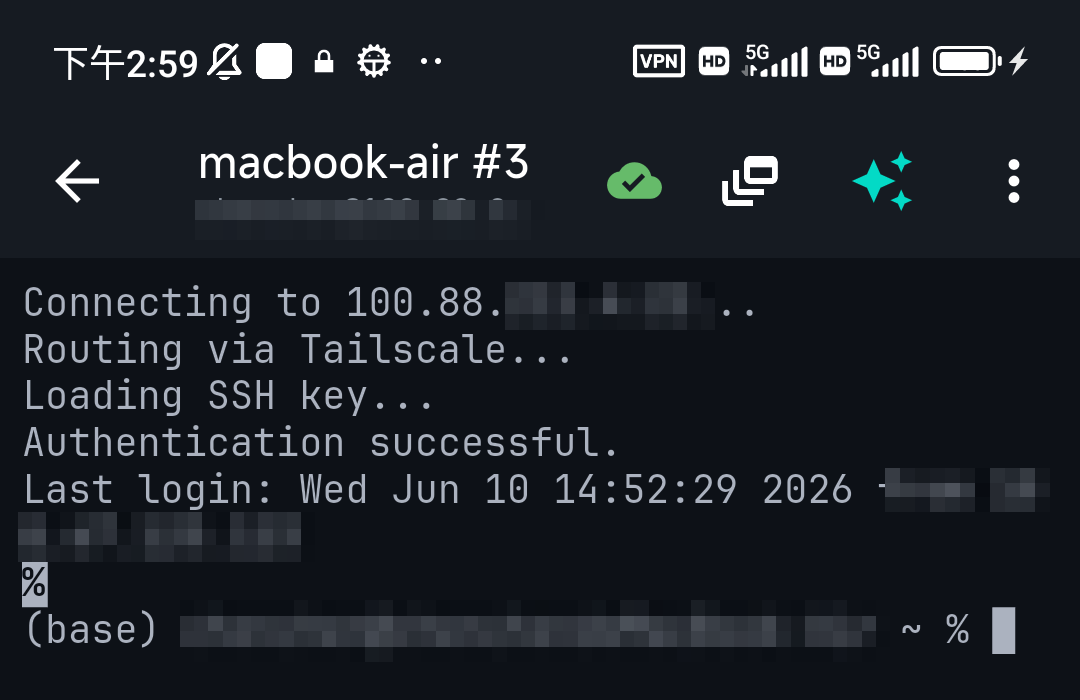
That last part matters on mobile: TermAI ships Tailscale inside the app, so you don't run a separate VPN client just to reach your boxes — you connect and the routing happens. With raw WireGuard you'd configure and run a system VPN tunnel yourself.
How to decide
- I want remote access to work with minimal setup → Tailscale.
- Devices are behind NAT/CGNAT, or roam networks → Tailscale.
- I'm SSHing into servers from a phone → Tailscale (built into TermAI).
- I want a single tunnel with no third-party coordination → raw WireGuard.
- I like the mesh model but must self-host the control plane → Headscale.
FAQ
Is Tailscale just WireGuard?
Tailscale uses WireGuard for its tunnels, but it isn't "just" WireGuard — it adds automatic key exchange, NAT traversal, device discovery, MagicDNS, and access control on top.
Is Tailscale faster than WireGuard?
When Tailscale makes a direct connection (the usual case), throughput is essentially the same as raw WireGuard, because the tunnel is WireGuard. Speed only drops if traffic must use a relay because a direct path can't be established.
Is Tailscale less secure because of the coordination server?
The coordination server brokers connections and distributes keys but isn't in your data path; your traffic is end-to-end encrypted between devices. If you'd rather control that server yourself, Headscale is a self-hosted alternative.
Which is better for a homelab?
For most homelabs, Tailscale — it handles NAT traversal and naming so you can reach everything without port forwarding. Choose raw WireGuard if you specifically want a single, fully self-managed tunnel.
Quick Facts
- Topic: Tailscale vs WireGuard for remote access and mobile SSH
- Key relationship: Tailscale is built on WireGuard — it's managed mesh vs hand-configured WireGuard
- Tailscale adds: automatic NAT traversal, key exchange, MagicDNS, and ACLs
- Speed: direct Tailscale tunnels run at WireGuard speed; relays add latency
- For phone SSH: Tailscale is the easy path; TermAI has it built in (no separate VPN app)
- Self-host the control plane: Headscale (open-source Tailscale coordination server)
Free on iOS and Android. 5 AI requests/day on the free tier, plus unlimited SSH/SFTP and built-in Tailscale.