The short answer
The best SSH client for Android in 2026 is TermAI for most people — it's phone-first, has an AI assistant that suggests commands you confirm before running, and includes Tailscale so you can reach servers behind a home router without a second VPN app. Termius is the pick if you need the same host list on a desktop. ConnectBot is the pick if you want free, open source, and no account. Termux isn't an SSH client at all — it's a Linux environment on the phone. And JuiceSSH, the app that used to win this list, is no longer an option: it was unpublished from Google Play in December 2025 and can't be installed by new users.
Pick in one line:
- Best Android SSH client overall — TermAI (free tier; AI + built-in Tailscale)
- Best free SSH app for Android — ConnectBot (open source, no account) or TermAI's free tier if you want SFTP and AI
- Best for desktop + phone sync — Termius (sync is the paid feature)
- Best Android terminal (not an SSH client) — Termux, from F-Droid or GitHub
- Came from Windows looking for PuTTY — there is no Android PuTTY; use TermAI or ConnectBot
"Android SSH client", "SSH client for Android", "Android SSH app", and "Android SSH terminal" are the same search with different wording — this page covers them all. Disclosure: TermAI is our own app; prices and status for every app below were re-checked against store listings and release history for 2026.
Android SSH apps at a glance (2026)
| App | Price (2026) | Type | Status | Stands out for |
|---|---|---|---|---|
| TermAI | Free tier; Pro $2.99/mo; Team $7.99/seat/mo | SSH + SFTP client | Active | AI assistant, built-in Tailscale, same app on iOS |
| Termius | Free Starter; Pro $10/user/mo billed annually | SSH + SFTP client | Active | Cross-platform sync with desktop |
| ConnectBot | Free, open source | SSH client | Active (1.10.x shipped in 2026) | No account, no cloud, minimal surface |
| Termux | Free, open source | Local Linux environment | Active (F-Droid/GitHub; Play build deprecated) | Running Linux tools on the phone itself |
| JuiceSSH | n/a — delisted | SSH client | Removed from Google Play, Dec 2025 | Nothing anymore — don't start here |
Termius Pro's $10/user/month is the annual-billing rate (~$120/year); month-to-month is meaningfully more. See Termius free vs paid for the full tier breakdown.
"Android SSH" means three different things — pick the right one
Most of the confusion in this category comes from three unrelated tools sharing one search term. Before comparing apps, work out which one you actually want:
- An SSH client — connects out from your phone to a remote server (a VPS, a Raspberry Pi, a NAS). This is what 90% of people mean, and it's what TermAI, Termius, ConnectBot, and JuiceSSH were.
- A terminal emulator / local shell — gives you a Linux shell running on the phone, with no server involved. That's Termux. You can type
sshinside it, but you get no host list, no key manager, no tap-to-connect. - An SSH server — lets another machine connect into your Android device. That's a separate setup, covered further down.
If you want to restart a service on a server from your phone, you want an SSH client. Everything in the next five sections is judged on that job.
TermAI — best overall in 2026
TermAI is an AI-native SSH client: describe what you want in plain English and it writes the command onto your input line, explains errors, and stays grounded in your session — you read and confirm before anything runs, and destructive commands take an extra confirmation. It also has built-in Tailscale (reach private servers with no separate VPN app and no port forwarding) and the same app on iOS, which matters if you carry both.
The free tier is unlimited SSH and SFTP plus 5 AI requests a day; Pro is $2.99/month and Team is $7.99/seat/month. The design choice worth knowing about is that the assistant is suggest-and-confirm by default, not an agent that executes on your behalf — on a 6-inch screen against a production box, that's the right default, and we argued it out in letting AI run shell commands on mobile, safely.
Best for: anyone who wants command help, SFTP, and a modern, actively-developed Android app.
Trade-off: mobile-only — there's no desktop client, so if you want one host list shared with a laptop, that's Termius's job.
Termius — best cross-platform sync
Termius is polished and syncs hosts, keys, and snippets across Android, iOS, and desktop. If you bounce between a phone and a laptop, that's the appeal — and it's the one thing no phone-first client can match.
The 2026 pricing picture is better than its reputation suggests: the free Starter plan includes SSH, SFTP, port forwarding, AI autocomplete, and a local vault, and Termius explicitly permits commercial use on it. What Starter withholds is synchronization — on the free plan your hosts and keys live on one device only. Paid tiers are Pro at $10/user/month billed annually (~$120/year), Team at $20, and Business at $30, with monthly billing priced higher. So on Android alone, free Termius is a capable client; you're paying for the laptop half.
Best for: people who want one client and one host list across phone and desktop.
Trade-off: sync requires an account and a subscription; the mobile app carries the weight of a desktop-first product. Weighing it against TermAI specifically? See TermAI vs Termius and Termius free vs paid.
ConnectBot — best free & open source Android SSH client
ConnectBot is the original Android SSH client and still the answer when the requirement is "free, open source, no account, no cloud." It's plain — a dated UI, no SFTP, no sync, no AI — but it's genuinely free with no tiers, it asks nothing of you, and it's still being released: the 1.10.x line shipped through 2026, which is more than most apps in this category can say.
The honest limitation is file transfer. ConnectBot does SSH sessions and tunnels, not SFTP, so "edit a config file from my phone" means nano over the session rather than pulling the file down. If that's a dealbreaker, TermAI's free tier includes SFTP and Termius Starter does too. Deciding between it and Termius? See Termius vs ConnectBot.
Best for: minimalists, privacy-first users, and anyone who wants zero accounts.
Trade-off: no SFTP, no sync, no modern conveniences.
Termux — a Linux terminal, not an SSH client
Termux comes up in every "best SSH app for Android" search, so it's worth being precise: it's a local Linux environment on your phone, not an SSH connection manager. You can pkg install openssh and run ssh user@host inside it, but there's no saved-host list, no key manager, no tap-to-connect, and no touch-friendly key row for the things a phone keyboard lacks. It's a package manager and a shell, and that's genuinely excellent when that's what you want — rsync, tmux, git, Python, all on-device.
Install it from the right place. This trips people up constantly: the official release channels are F-Droid and GitHub, and the Google Play build is deprecated — it exists, but with missing functionality compared to the F-Droid build. Because the two are signed with different keys, you can't update across them; switching means uninstalling Termux and all its plugin apps first. If you installed Termux from Play years ago and it feels broken, that's usually why.
More in Termius vs Termux, ConnectBot vs Termux, and running Linux on Android.
JuiceSSH — removed from the Play Store, don't start here
This is the biggest change to the Android SSH landscape since we first wrote this page, and most comparison articles still haven't caught up. JuiceSSH was unpublished from Google Play in December 2025 (11 December, per AppBrain's tracking — neither Sonelli nor Google issued a statement). It wasn't removed for anything it did; it was removed for what it stopped doing. Its last release was v3.2.2 on 4 February 2021, and Google Play requires apps to keep targeting a recent Android API level to stay listed. Four years of silence made that impossible.
Two consequences matter if you're reading this list to choose an app:
- You can't install it. The listing is gone, so it won't appear in Play search. Users who had it before removal may still find it under "My apps," but that isn't something to build on.
- The Pro licence check broke. Users have reported since December 2025 that Pro purchases made before that date stopped being recognised, with support unresponsive. The likeliest explanation discussed publicly is infrastructure rot rather than anything deliberate — the effect on you is the same.
Sideloading the APK from a mirror is a bad trade specifically because of what this app is: a 2021 binary with 2021 crypto, from an unverified source, holding the private keys to your servers. If you're still on it, the migration order matters — add your new key to authorized_keys before revoking the old one, or you'll lock yourself out of a box you can only reach from your phone. Full walkthrough in JuiceSSH was removed from the Play Store, with the alternatives compared in Is JuiceSSH dead? and Termius vs JuiceSSH.
Best for: nobody, in 2026.
Trade-off: not installable, not maintained, not patched.
What about PuTTY for Android?
A lot of people arrive from Windows searching for "PuTTY for Android" — but there is no official PuTTY for Android. PuTTY is a Windows desktop program; the third-party "PuTTY" apps in the Play Store are unrelated repackages by other developers, and an SSH client is a bad place to trust an unknown publisher. On Android you want a purpose-built mobile client instead: TermAI, ConnectBot, or Termius all do what you came for, with a proper host list and touch-friendly keys.
The habits transfer more than you'd expect — saved sessions become saved hosts, and your .ppk key can be converted to OpenSSH format before importing. We go deeper in PuTTY for Android & iPhone.
Apps you'll see recommended that aren't Android options
Roundups mix platforms constantly. To save you a Play Store search that goes nowhere:
- Blink Shell — iOS and iPadOS only. No Android build. (Blink vs Termius.)
- Prompt — iOS and iPadOS only, from Panic.
- PuTTY, MobaXterm, Tabby, Warp — desktop programs. None has an Android client.
- "Server Auditor" — this is just Termius's old name; you'll still see it in older articles.
- "Terminus" — a common misspelling of Termius, and also the former name of the Tabby desktop terminal. Different things.
How to SSH from Android, step by step
Whichever client you pick, the first connection is the same five steps and takes about five minutes. You need three things: the server's address, a username, and either a password or an SSH key.
- Install a client and open it. With TermAI you don't need an account to make your first connection.
- Add the connection — a label, the host (an IP like
192.0.2.10or a name likepi.local), the port (22 unless you changed it), and your username (root,ubuntu,pi). - Choose password or key. Password is quickest to test with; a key is the right long-term answer. Generate one in the app and add its public half to the server's
~/.ssh/authorized_keys, or import an existing private key — it stays in the phone's secure keystore. - Connect and trust the host key. The first time, you'll be asked to accept the server's fingerprint. That's normal — it's how SSH pins the server's identity.
- Learn the shortcut key row. Esc, Tab, Ctrl, and arrows are what make
Ctrl+C, tab-completion, andvimusable on a touchscreen.
The full walkthrough with screenshots — including SSH from Android to a Raspberry Pi, to Windows via OpenSSH Server, and to a Mac — is in how to SSH from Android. If the connection won't go through, connection refused and the troubleshooting guide cover the usual causes.
What makes an Android SSH terminal actually usable
Feature lists don't tell you which app you'll still be using in a month. These are the things that decide it on a phone:
- A dedicated key row. Esc, Tab, Ctrl, Alt, and arrows aren't on a stock Android keyboard. Without a persistent row,
Ctrl+Candvimare effectively unavailable — this is the single biggest usability gap between clients. - Correct terminal emulation. You want real xterm-256color behaviour so
htop,nano,tmux, and colour output render properly rather than smearing escape codes across the screen. - Selection and copy/paste that works with a finger. Long-press to select a block of error output, then copy it — or, in TermAI, hand that exact text to the assistant with Ask AI instead of retyping a stack trace into a search box.
- Font size and pinch-to-zoom. 80 columns on a 6-inch screen is a real constraint; being able to zoom out for
htopand back in to type matters more than it sounds. - Hardware keyboard support. If you ever pair a Bluetooth keyboard or dock the phone, the client should pass through Ctrl and Alt properly.
Android-specific things that actually matter
The "best" app on Android isn't only about features — it's about the things that break on a phone specifically:
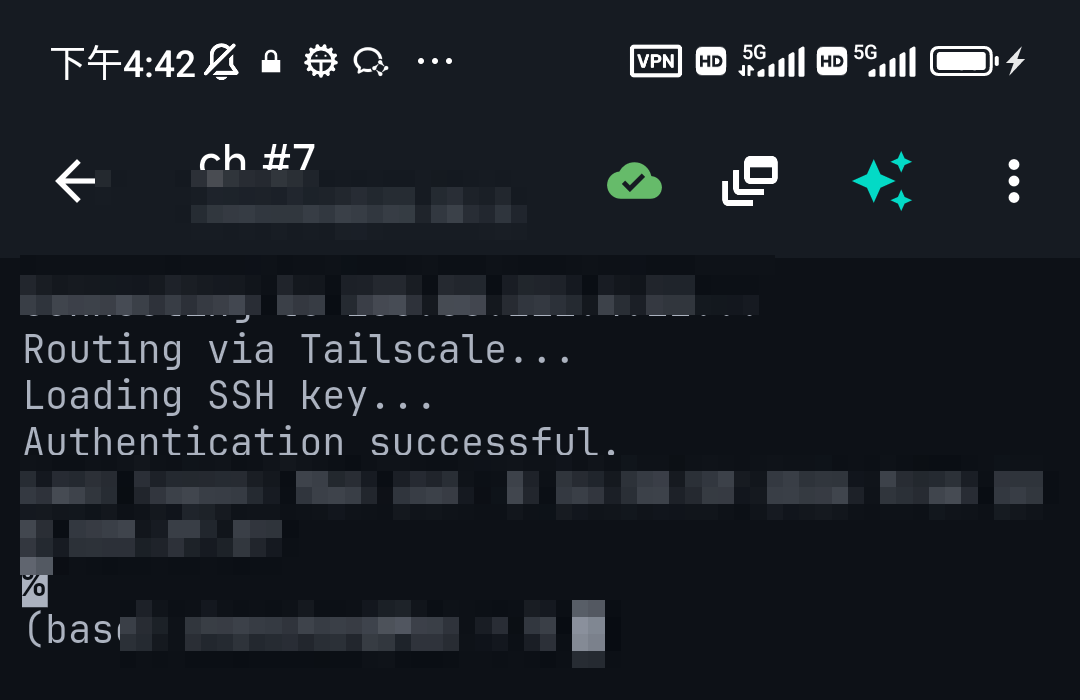
- Surviving backgrounding. This is the number-one Android SSH complaint, and it's a platform behaviour, not a bug in your app: Doze and App Standby defer background network activity, and Android 16 added a harsher Restricted bucket for apps you haven't opened in days. A good client keeps the session alive or reconnects cleanly when you switch away and back — TermAI auto-reconnects with retries rather than dropping you at a dead prompt. If sessions still die on your device, set the app's Battery usage → Unrestricted in Android's app settings; aggressive OEM battery managers (Xiaomi, Samsung, Huawei, OnePlus) are usually the real culprit.
- Key import, not just key generation. You should be able to import or paste an existing
ed25519or RSA private key, not only create a new one. See Ed25519 vs RSA if you're choosing a key type, and copying a key to a server for the other half. - Where the private key is stored. Prefer a client that keeps keys in the Android keystore behind biometric unlock over one that keeps a plaintext file. Your phone is the device most likely to be lost.
- Reaching private servers. Home-lab and work boxes usually aren't on the public internet, and port-forwarding 22 to the world is the wrong fix. TermAI has built-in Tailscale so you reach them directly with no second VPN app running in the background — or see accessing a home server from anywhere.
- Agent forwarding & jump hosts. If you hop through a bastion to an internal server, check your pick supports the multi-hop flow (ProxyJump / agent forwarding) you need. If reaching internal boxes is the whole reason for the bastion, a mesh VPN removes the jump host in many setups.
- Mobile networks drop. Switching Wi-Fi to LTE kills a plain TCP session. Auto-reconnect covers most of it; if you live on flaky connections, Mosh vs SSH explains the roaming-session alternative, and keeping a process running after disconnect is the fix for long jobs.
Running an SSH server on Android (connecting into your phone)
The reverse direction — SSH from a laptop into the phone — is a different job, and no SSH client does it. The standard route is Termux:
pkg update && pkg install opensshsshdto start the server. It listens on port 8022, not 22, because Termux runs as a normal unprivileged user and can't claim a low port.- Get your username with
whoami, then connect from the other machine withssh -p 8022 user@phone-ip. - Key auth is the intended path — put your laptop's public key in
~/.ssh/authorized_keyson the phone. (passwdsets a password, but keys are the better answer for a device on a shared network.) termux-wake-lockkeeps it running when the screen sleeps.
This is genuinely useful for pulling files off the phone or scripting against it — and it's a good reminder that "Android SSH" splits into two completely different setups depending on which way the connection goes.
Best mobile SSH client (Android and iPhone)
If you carry both, the shortlist collapses fast, because most of this category is single-platform. TermAI and Termius are the two that ship the same client on Android and iOS — TermAI as a phone-first app with AI and Tailscale on a $2.99/month Pro tier, Termius as the mobile end of a desktop product with sync as the paid feature. Blink Shell and Prompt are iOS-only; ConnectBot and Termux are Android-only. For the iPhone-side view see the best SSH client for iPhone and the iPad roundup; for the cross-platform-including-desktop view, the best SSH client in 2026.
How to pick
- Want AI help + SFTP + a modern app → TermAI
- Need the same host list on a desktop → Termius
- Free, open source, no account → ConnectBot
- Free but you also want SFTP → TermAI free tier or Termius Starter
- Run Linux on the phone itself → Termux, from F-Droid or GitHub (not an SSH client)
- SSH into your phone → Termux's
sshdon port 8022 - Reaching a home server or a box behind NAT → a client with Tailscale built in
- Came looking for PuTTY → there's no Android PuTTY; use TermAI or ConnectBot
- Still on JuiceSSH → migrate now, rotating keys as you go
FAQ
What is the best SSH client for Android?
TermAI for most people in 2026 — it's built for the phone, has an AI assistant that suggests commands you confirm before running, includes SFTP on the free tier, and has Tailscale built in for servers behind a router. Choose Termius instead if you need desktop sync, or ConnectBot if you want free and open source with no account.
What's the best free SSH app for Android?
ConnectBot is fully free and open source with no tiers at all. TermAI's free tier adds SFTP and 5 AI requests a day, and Termius's free Starter plan includes SSH, SFTP, and port forwarding — with sync as the paid feature. All three are legitimate free options; the difference is what you get beyond a plain terminal.
Is JuiceSSH still available?
No. JuiceSSH was unpublished from Google Play in December 2025 after its last release in February 2021, and new users can't install it. Pro licence validation has also broken for many existing users. Migrate to TermAI, Termius, or ConnectBot — and rotate your keys while you do.
Is there a PuTTY for Android?
No official one — PuTTY is a Windows program, and the "PuTTY" apps on Play are unrelated third-party repackages. Use a native Android SSH client like TermAI or ConnectBot instead; you can convert a .ppk key to OpenSSH format and import it.
Which Android SSH app has AI?
TermAI is AI-native and includes the assistant on its free tier (5 requests/day). Termius includes AI autocomplete/command generation in its free Starter plan, with a separate conversational agent on a beta track. The design difference matters: TermAI suggests and waits for your confirmation rather than executing on your behalf.
How do I SSH from Android?
Install an SSH client, add a connection with the host, port 22, and your username, pick password or key authentication, then accept the server's host key on first connect. It takes about five minutes — the step-by-step guide has screenshots.
Is Termux an SSH client?
Not really. Termux is a Linux terminal environment on the phone; ssh is one command you can install inside it. There's no saved-host list, key manager, or tap-to-connect. Use Termux when you want Linux tools on-device, and an SSH client when you want to manage remote servers. Install it from F-Droid or GitHub — the Play Store build is deprecated.
Can I SSH into my Android phone?
Yes, but that's the reverse direction and needs a server, not a client. Install OpenSSH in Termux and run sshd; it listens on port 8022 because Termux can't bind a privileged port. Connect with ssh -p 8022 user@phone-ip.
Why does my SSH session disconnect when I switch apps?
Android's Doze and App Standby suspend background network activity, and Android 16 added a stricter Restricted bucket for apps you haven't opened recently; OEM battery managers are often more aggressive still. Set the app's battery usage to Unrestricted, and prefer a client that auto-reconnects. For long-running jobs, run them under tmux or screen so the work survives the disconnect entirely.
Does any Android SSH client support SFTP?
TermAI and Termius both include SFTP file transfer, on their free tiers. ConnectBot does not — it's sessions and tunnels only. If you need to move files rather than just run commands, that's the deciding factor.
Do I need root on my phone to use SSH?
No. Android SSH clients are ordinary apps and don't require root. Even running an SSH server via Termux doesn't need root — that's exactly why it uses port 8022 instead of 22.
What should I look for in an Android SSH client?
Saved hosts with private-key import, keys stored in the Android keystore behind biometric unlock, a special-keys row (Esc/Ctrl/Tab/arrows), sessions that survive backgrounding, SFTP, and — increasingly — an AI assistant and a way to reach machines behind NAT.
Is SSH on Android safe?
Yes, with the usual conditions: install only from official stores (an SSH client is the worst possible app to sideload), use keys rather than passwords, keep the key behind the device's biometric lock, and use a maintained app — an unpatched client is the actual risk, which is the whole lesson of the JuiceSSH story. More in SSH keys vs passwords.
Quick Facts
- Topic: best SSH app / SSH client for Android in 2026
- Best overall / AI-native: TermAI (free tier with SSH + SFTP and 5 AI requests/day, Pro $2.99/mo, built-in Tailscale, iOS too)
- Best desktop sync: Termius (free Starter includes SSH/SFTP; Pro $10/user/mo annual, sync is the paywall)
- Free & open source: ConnectBot (no SFTP; 1.10.x releases shipped in 2026)
- No longer an option: JuiceSSH — unpublished from Google Play in December 2025, last release February 2021
- Not an SSH client: Termux (local Linux environment; install from F-Droid or GitHub, Play build deprecated)
- SSH into Android: Termux
sshd, port 8022 - PuTTY for Android: doesn't exist; use a native SSH client
Free on iOS and Android. 5 AI requests/day on the free tier, plus unlimited SSH/SFTP and built-in Tailscale.